

About the gallery
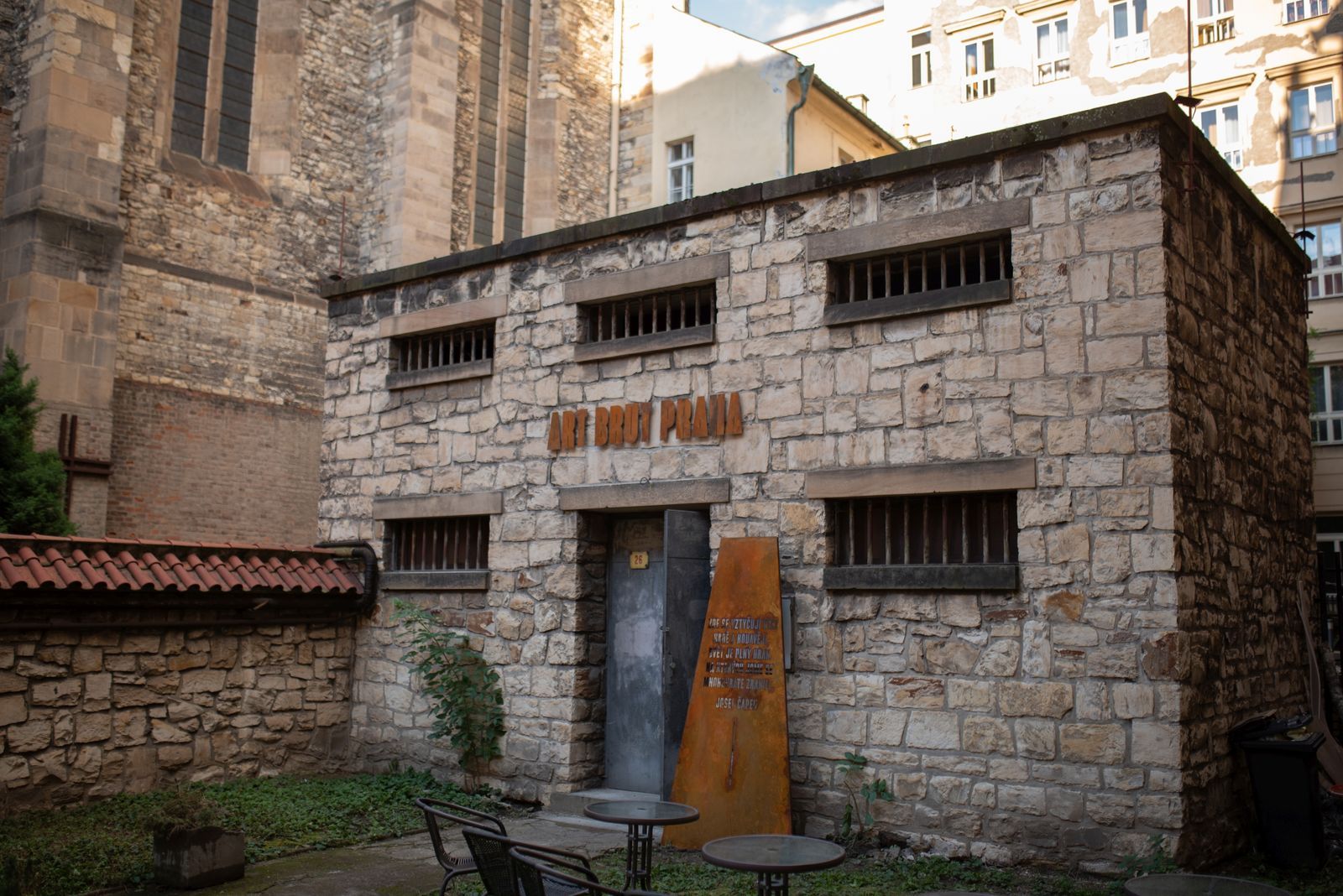
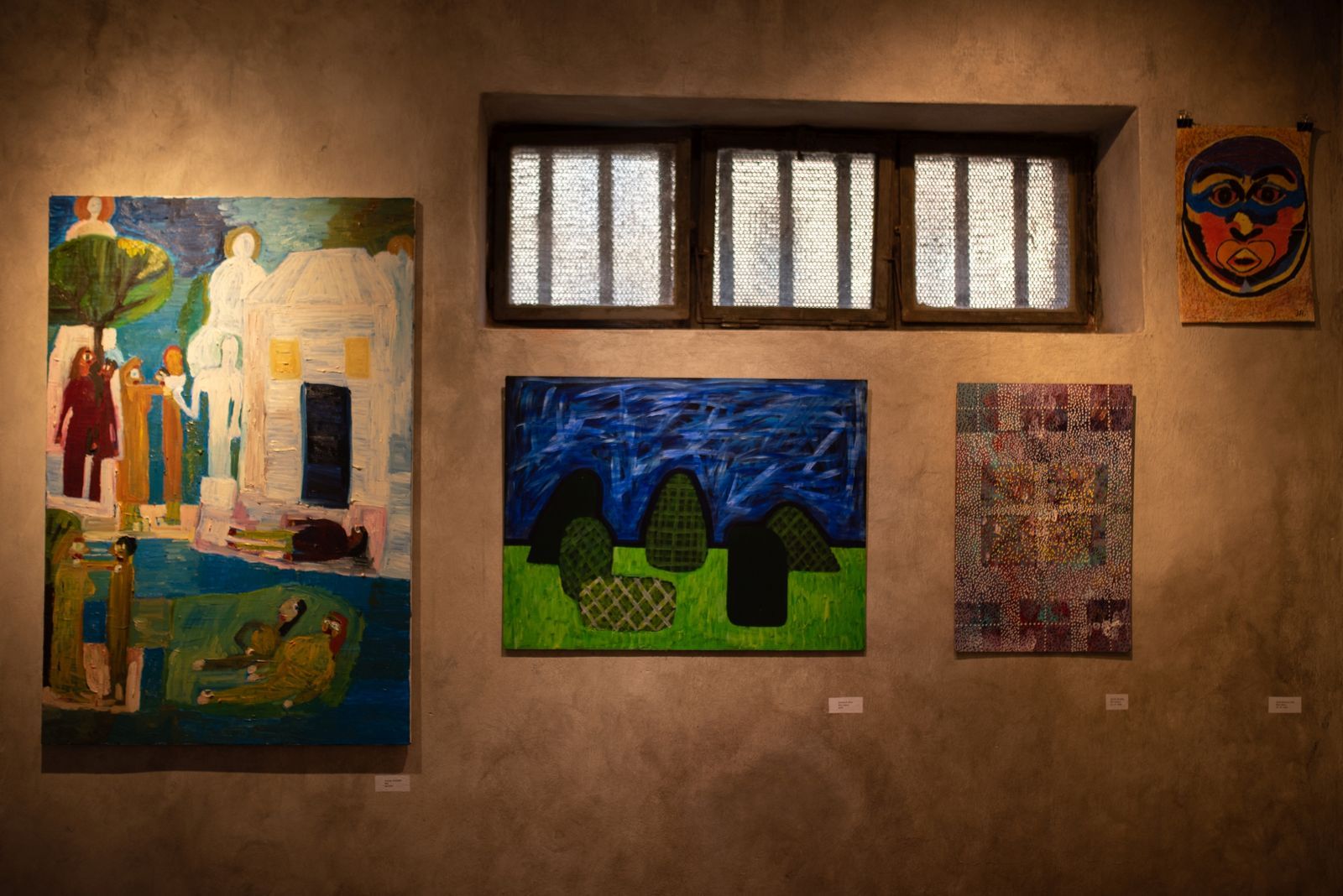
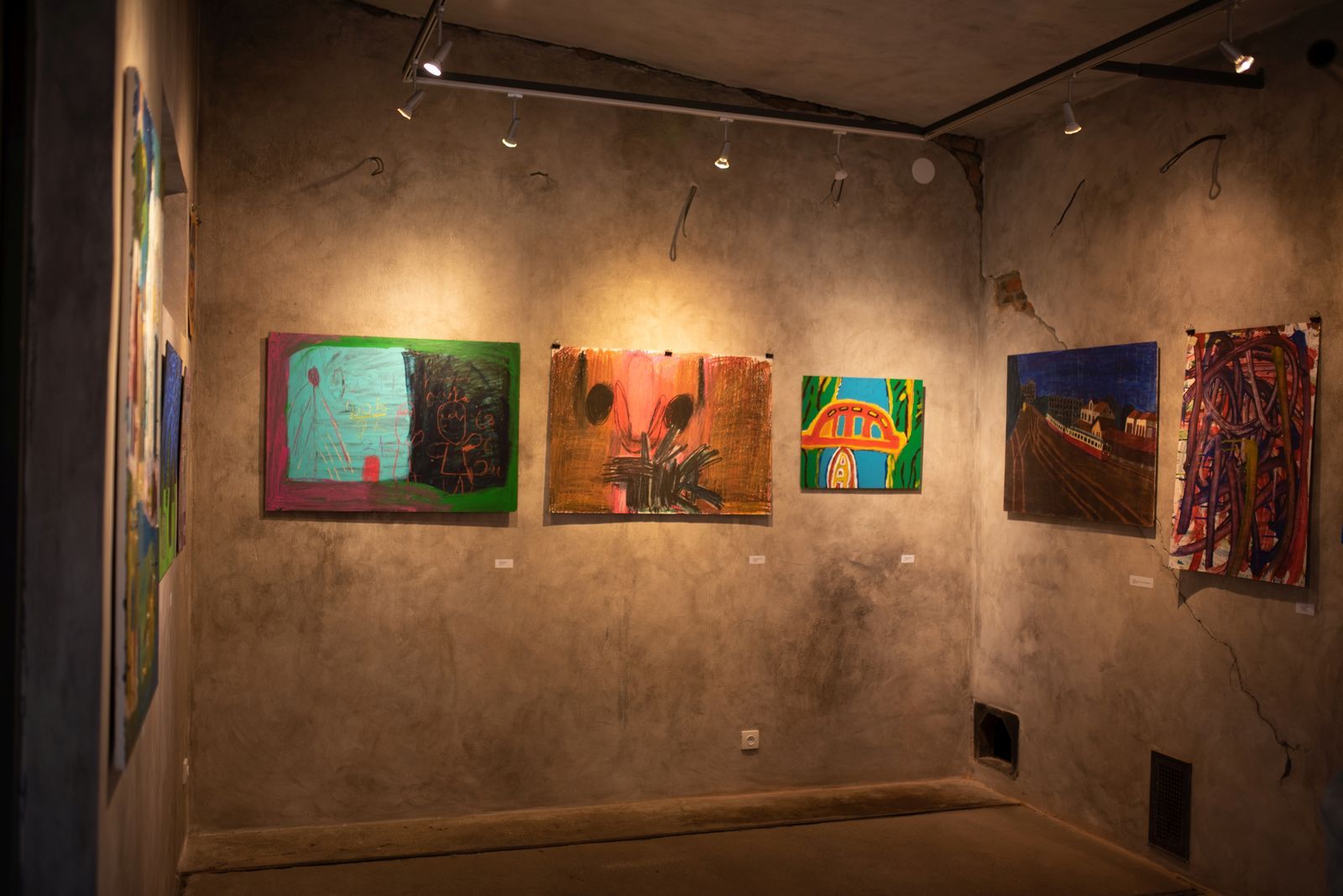
We are opening the Art brut Prague Gallery as the first exhibition space in Prague focused exclusively on the work of artists who, for various reasons, are unable or unwilling to join the mainstream art scene.
“Here, things are raised proudly
and more stabbingly,
the world is full of edges
on which we have
hurt ourselves many times.”
The quote, taken from Josef Čapek’s groundbreaking book The Most Modest Art, will greet all visitors at the entrance as a foreshadowing of the type of work they will encounter here.
To clearly define the gallery, the name was chosen after the painter Jean Dubuffet’s famous term art brut – usually translated in Czech as “art in its raw state”.
But not all the artists the gallery will represent necessarily fall into the category of art brut as it is usually conceived. Some of them, for various reasons, become outsiders, not even classifiable in this field.
The selection of the artists is basically conditioned by the absence of any conscious calculation in their work aimed at achieving success in the world of contemporary art.
The gallery also wants to support its artists by making their works available for sale.
Exhibitions
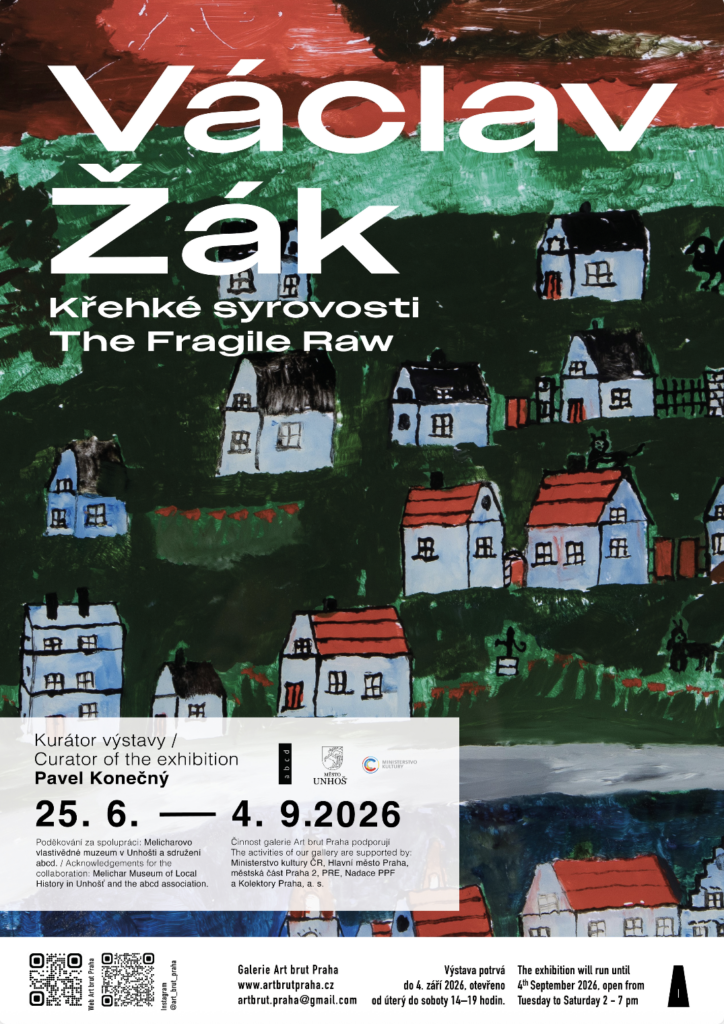
Václav Žák
The Fragile Raw
Křehké syrovosti
25. 6.–4. 9. 2026
Curator of the exhibition: Pavel Konečný
Václav Žák (November 1, 1906 – January 6, 1986) was born in Velké Přílepy near Kladno into a steelworker’s family. A physical disability left him unable to use his paralyzed right hand. This, combined with the fact that he only completed five years of primary school, left a devastating mark on his entire life. The hardships and bullying of his childhood were later replaced by everyday worries and a long struggle to find work. Ultimately, he made a living as a ragman and by collecting rabbit and goat skins from people across the wider region, which he traveled around on his modified tricycle.
He began creating art spontaneously as a self-taught artist at the age of forty-six. From 1952 onwards, he painted on literally everything around him that could take a coat of paint. He started with the glass veranda of his small house in the settlement of Unhošť-Amerika, eventually covering not only the facade but also the entire interior, including the furniture, with vibrant paintings. Through this unconventional approach, he originaly and stubbornly gave form to his dreams and visions, which blended freely with elements of everyday reality, often in unexpected contexts.
His distinctive and, in many respects, wild artwork did not escape the attention of other artists. At the turn of the 1950s and 1960s, they began visiting him, drawn both to his environmental creativity and his extensive collection of unique reverse glass paintings. These became his signature medium, with the total number of these works reaching an impressive 600 to 700 pieces.
Václav Žák’s star shone brightest during the creative and free-spirited atmosphere of the 1960s, most notably in director Evald Schorm’s short film The House of Joy (Pearls of the Deep, 1965), based on a screenplay by Bohumil Hrabal. Fortunately, the film brilliantly documented and captured the genius loci of Žák’s artistic poetry on the walls of his own home, as well as his authentic, raw expression.
Today, we can read Žák’s remarkable body of work (alongside theorist Alena Nádvorníková) as the expression of an Art Brut creator “building his own realm of freedom, from which an almost unbelievable purity and freshness blows upon the viewer.”
Pavel Konečný
About the authors
The main circle of authors is formed by the persons who create in the Studio of Joyful Creation at Letná: Dagmar Filípková, Šárka Hojaková, Dominik Jirsa, Jarmila Jandová, Marie Kohoutková, Václav Kuklík, Marie Kůsová, Lorenzo, Karel Pajma, Lukáš Paleček, Vojtěch Proske, George Radojčič, Iveta Horváthová (Rimini Filí), Ladislav Svoboda, Vojtěch Šůra will be presented here.
However, internationally known names such as Anna Zemánková or Zdeněk Košek will also be represented. Other authors who have already gained attention include Hana Fousková, La Inthonkaew, Ota Prouza, Helena Skalická and Tomáš Krupka.
Practical information
The gallery will be open five afternoons a week, Tuesday to Saturday 2 – 7pm.
www.artbrutpraha.cz
artbrut.praha@gmail.com
+420 606 028 942 (during opening hours)
+420 602 646 665 (out of hours)
Postal address: Galerie Art brut Praha, Resslova 300/6,
120 00 Praha 2 – Nové Město.
About the place and the founder
The gallery acquired its space after the renovation of a long unused technical building at St. Wenceslas Church in Zderaz.
The operator is the Altán Art association, which has so far been active mainly in Letná: in 2013 it opened the Studio of Joyful Creation here as the first Czech studio providing facilities for artists falling into the category of art brut, and in 2017 it opened up also to the wider public by establishing the ART Cultural and Community Centre, where senior citizens and people with disabilities develop their artistic interests together. Vladimír Drábek is the main representative of the association. More information on the website www.altanart.cz .
Curator
Jaromír Typlt (1973) is a poet, performer and essayist. During 2000-2010 he worked in Liberec as a curator of photography and contemporary art exhibitions at the Small Exhibition Hall and then at the U Rytíře Gallery. Since the end of the 1990s he has also helped to promote the work of overlooked authors, publishing the first book on Zdeněk Košek (2001), literary texts by Hana Fousková, František Novák and many others. In 2018, he started cooperation with the association Altán Art. He has long focused on the topic of “écrits bruts” – written expressions in art brut.
Gallery partners
Studio of Joyful Creation at Letná
Czechoslovak Hussite Church in Prague 2 – New Town
Graphic studio chapter
abcd praha
Media partners
Analogon
Revolver Revue
Souvislosti
I am convinced that a considerable circle of artists, those interested in art brut and the
Pavel Konečný, art brut collector
professional public can form around the Art Brut Prague gallery in a very short time. The
project is a positive response not only to initiatives stemming from the vibrant undercurrent of
our spontaneous creativity, but also responds to calls from foreign cultural institutions to
strengthen the voice of outsider art, including by improving intercultural cooperation and
dialogue across European borders.